Starter
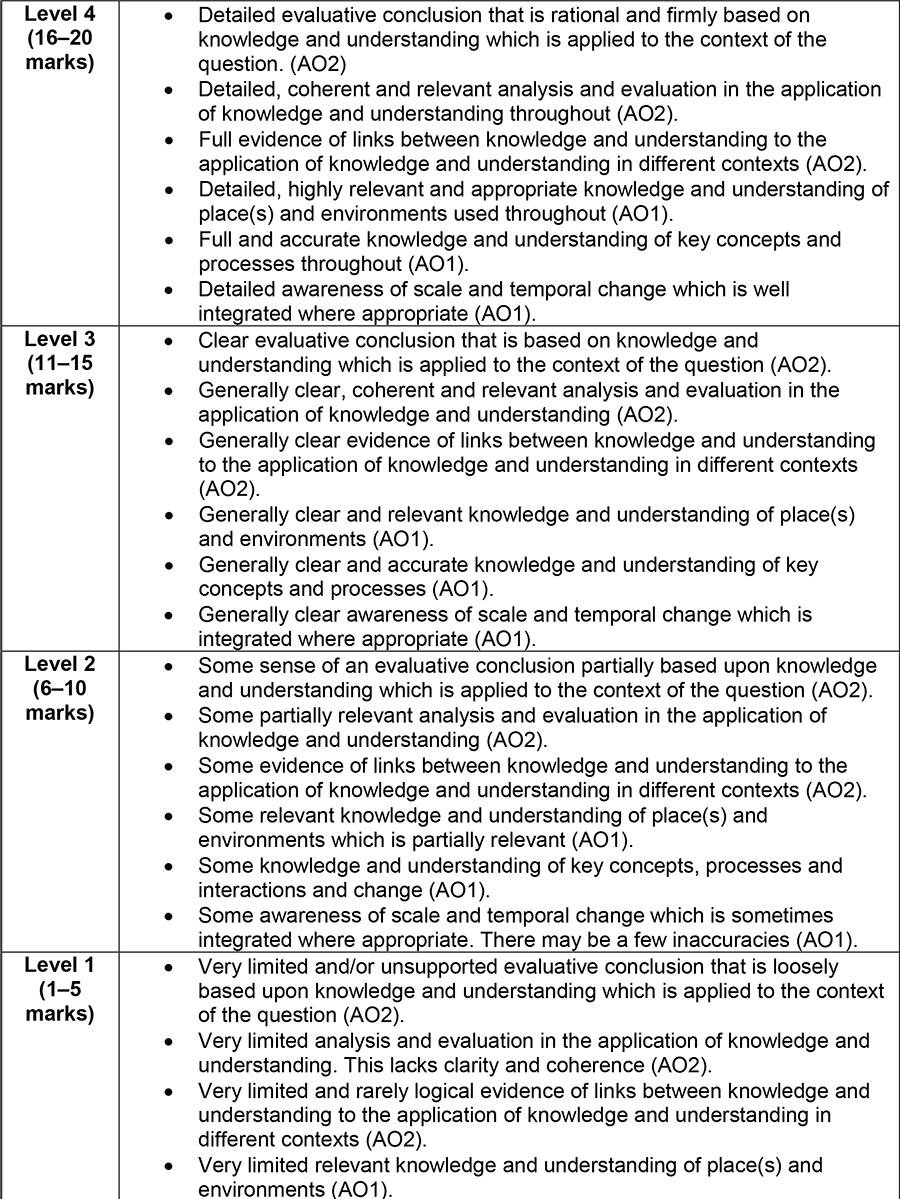
Look at the marking grid below – what is needed to get a top mark for a 20 mark answer?

|
Essay writing
Before you start to write an essay you must have a plan of what you will write, either in your head or on paper. All such pieces of writing must have:
- a beginning (the introduction),
- a middle section (argument) and
- an ending (conclusion).
|
Essay writing
The introduction
- This does not have to be long
- a few sentences should
be sufficient. It may define the terms set out in the
question, set the scene for the argument to follow or
provide a brief statement of the idea or viewpoint to be
developed in the main part of the answer.
|
Essay writing
The argument
- This is the main part of the answer. It should consist
of a series of paragraphs, each developing one point
and following on logically from the previous one. Try to avoid paragraphs that list information without
any depth, and avoid writing all you know about
a particular topic without any link to the question
set. Make good use of exemplar material, naming
real places and make them count by giving accurate
details specific to those locations. You should aim to
demonstrate good, and often critical, knowledge and
understanding of concepts.
|
Essay writing
The conclusion
- The conclusion, like the opening, should not be too
long. It should reiterate the main points as stated in the
introduction, but now supported by the evidence and
facts given in the argument. It must address the command
word/s given in the question such as ‘assess’, or ‘evaluate’.
|
Essay writing
Should you produce essay plans in the examination?
- If you produce an essay plan at all, it must be brief, taking only 2 or 3 minutes to write on a separate piece
of paper. The plan must reflect the above formula and
make sure that you stick to it. Be logical, and only
write an outline, retaining the examples in your head
to use at the most appropriate point in your answer.
|
Essay writing
Other important points
- Always keep an eye on the time. Make sure that you
write clearly and concisely. Do not give confused
answers, endlessly long sentences or pages of prose
with no paragraphs. Above everything, carefully read
the question and answer the question as it has been set.
|
Essay writing
How are questions marked?
- Most questions at both AS and A-level are marked
using a levels of response mark scheme. Such a
scheme is broken down into levels, each of which has
a descriptor. At each level the descriptor denotes the
average performance expected for that level. Essay-type response will be marked
using four levels (assuming a 20-mark maximum for
the question).
|
PEEL Paragraph
POINT
List your point with key words and ideas.
- ‘One argument is…’
- ‘Some geographers/scientists believe...’
|
PEEL Paragraph
POINT
EVIDENCE
Make reference to an example relating to the topic to support your point.
- ‘A recent example of this is…’
|
PEEL Paragraph
POINT
EVIDENCE
EXPLAIN
Explain the evidence - expand on your point to include Geographers/scientists, facts and relevant concepts and key terms.
- ‘This means that...’
- ‘This is important because...
|
PEEL Paragraph
POINT
EVIDENCE
EXPLAIN
LINK BACK TO THE QUESTION
A mini conclusion about the points made relating it back to the question.
- ‘Therefore…’
- ‘It is clear that…’
|
Essay writing
Level 1 (1−5 marks)
Level 1 answers are likely to show the following
characteristics:
- will present a very limited and/or unsupported
evaluative conclusion that is loosely based upon
knowledge and understanding which is applied to
the context of the question
- there will be very limited analysis and evaluation in
the application of knowledge and understanding. The
answer lacks clarity and coherence in this respect
- there will be very limited and rarely logical evidence
of links between knowledge and understanding to
the application of knowledge and understanding in
different contexts
- there will be very limited relevant knowledge and
understanding shown of place(s) and environments
- knowledge and understanding of key concepts and
processes will be very isolated
- there will be very limited awareness of scale and
temporal change which is rarely integrated where
appropriate
- there may be a number of inaccuracies within the text.
|
Essay writing
Level 1 (0−5 marks)
Level 2 (6−10 marks)
Level 2 answers are likely to show the following:
- some sense of an evaluative conclusion partially
based upon knowledge and understanding which is
applied to the context of the question
- shows some partially relevant analysis and evaluation
in the application of knowledge and understanding
- reveals some evidence of links between knowledge
and understanding to the application of knowledge
and understanding in different contexts
- shows some partially relevant knowledge and
understanding of place(s) and environments
- reveals some knowledge and understanding of key
concepts, processes and interactions and change
- shows some awareness of scale and temporal change
which is sometimes integrated where appropriate
- there may be a few inaccuracies in the text.
- there may be a number of inaccuracies within the text.
|
Essay writing
Level 1 (0−5 marks)
Level 2 (6−10 marks)
Level 3 (11−15 marks)
Level 3 answers are likely to show the following:
- shows clear evaluative conclusions that are based on
knowledge and understanding which is applied in
the context of the question
- reveals generally clear, coherent and relevant
analysis and evaluation in the application of
knowledge and understanding
- shows generally clear evidence of links between
knowledge and understanding to the application
of knowledge and understanding in different
contexts
- shows generally clear and relevant knowledge and
understanding of place(s) and environments
- reveals generally clear and accurate knowledge and
understanding of key concepts and processes
- shows generally clear awareness of scale and
temporal change which is integrated where
appropriate.
|
Essay writing
Level 1 (0−5 marks)
Level 2 (6−10 marks)
Level 3 (11−15 marks)
Level 4 (16−20 marks)
Level 4 answers are likely to show the following:
- reveals detailed evaluative conclusions that are rational
and firmly based on knowledge and understanding
which is applied to the context of the question
- makes a detailed, coherent and relevant analysis
and evaluation in the application of knowledge and
understanding throughout
- shows full evidence of links between knowledge and
understanding to the application of knowledge and
understanding in different contexts
- reveals a detailed, highly relevant and appropriate
knowledge and understanding of place(s) and
environments and used throughout the answer
- shows, throughout the answer, a full and accurate
knowledge and understanding of key concepts and
processes
- has a detailed awareness of scale and temporal
change which is well integrated where appropriate.
|
Task:
Answer the following exam question in exam conditions:
"The Disaster Response Curve (The Park Model) has contributed to improved understanding and therefore management of the impact of tropical storms".
To what extent do you agree with this view?
[20 marks]
|
Task: Mark Scheme
AO1
- Knowledge and understanding of the theoretical approaches to hazard management. Knowledge of hazards associated with tropical storms.
AO2
- Application of knowledge and understanding in analysis and evaluation of the extent to which theoretical models can assist in developing understanding of the management of the impact of tropical storms. There should be some evaluation of the extent to which the statement is valid.
|
Task: Mark Scheme
AO1
- The Park Model (some may refer to the Disaster Response Curve) – How this model can be used to identify the stages in the recovery of a community from a natural disaster. There should be knowledge and understanding of how the model can assist in the planning for future hazards and therefore improve outcomes of future of events by reducing impacts.
- Human responses of adaptation mitigation and prediction in the management of hazards.
- Other human responses such as fatalism and risk sharing. These may be considered as other factors which contribute to improved understanding and response to hazards.
- Other models associated with natural disasters such as the Hazard Management Cycle. This model has similarities and differences with Park’s model. The role of expertise is a feature in the hazard management cycle but this is not referred to in Park’s Model.
- Knowledge and understanding of the hazards associated with tropical storms. These impacts follow many similarities where the storms occur. However, there are also difference depending upon the choice of supporting material and exemplification.
- Management of the hazards associated with tropical storms such as early warning, meteorological tracking, building design, evacuation planning, exclusion zones, land use planning and modification of the loss. These should be considered in the context of Park’s model, i.e. where each aspect of management fits within the model.
- Impacts and human responses as evidenced by two recent tropical storms in contrasting areas of the world. This support may be used to challenge or support the thrust of the statement posed in the question.
|
Task: Mark Scheme
AO2
- The response should be framed in the context of an analysis and evaluation of the effectiveness of the Park Model in understanding and therefore managing the impact of tropical storms.
- Analysis – By analysing the model in advance of an impending storm, planners can ascertain the normal progression through a disaster. This will enable advanced planning to take place to mitigate against the expected impacts of the storm.
- Analysis – responses may explore various stages in the model and link this to management of tropical storms. More sophisticated responses may not start their analysis at stage one. Planners and managers invariably start at stage 5 ie what can be learned from a previous disaster. From this arises the mitigation strategies:
1. Hazard Resistant Design – this focuses on protection against both the storm surge and wind hazards. The storm surge hazard can be reduced by engineering structures such as sea walls, breakwaters, flood barriers and levees. Levee failure was a major cause of the flooding in New Orleans during Hurricane Katrina.
2. Building design (mitigation and/or adaptation depending on approach taken) can protect against the storm surge by raising the building on stilts, and by using concrete or brick rather than wood or straw which can be more easily swept away. Building design can do much to reduce the wind hazard.
3. Prediction and warning – coastal areas at risk of flooding are protected by warning systems. These aim to monitor tropical cyclone development and forecast their intensity and tracks so that the population can prepare themselves by moving to shelters or by evacuating their property and moving away from the danger area temporarily.
4. Predictions are based on models of atmospheric circulation and tracks of previous hurricanes. The difficult part of the process is interpreting the data for warning purposes. If the population at risk are warned and evacuated then lives may be saved. However, if warnings prove wrong there are high economic losses from evacuation and therefore lost production. There is also the impact on the population in terms of their reaction to future warnings. Too many erroneous warnings may produce complacency, and warnings must be issued in a way which will not cause panic.
5. Community Preparedness (mitigation and adaptation depending on approach taken) – if warnings are to be effective, the authorities and public must be aware of the specific actions to take. Dissemination of information to the public and evacuation procedures need to be planned in advance.
6. Land Use Planning (mitigation and/or adaptation depending on approach taken) – is most effective in the coastal zone most at risk from storm surges. Past tropical cyclone data and coastal topography can be used to identify areas at high risk. The aim is to limit development in these areas to uses more compatible with flooding such as beaches and parkland.
- Beware of lengthy description of management strategy. There should be clear reference to the extent to the strategy ‘fits’ within Park’s Model and has contributed to improved understanding and therefore response. Some may evaluate each approach, but this must be undertaken within the context of the question.
- Analysis – There are a variety of time scales in which the Park Model operates could take in response to this question. Some may frame their responses within these different time scales. Management at different time scales:
1. Short term – Stage 1 – eg prediction
2. Medium term Stages 2, 3 and 4 – eg relief efforts, initial recovery aiming for normality
3. Longer term – Stage 5 – eg revised management plans aiming to prevent repetition, rebuilding and improving systems of prediction and protection, investment to restore/improve normality.
- Evaluation – Some may refer to alternative models which provide a contrasting approach to hazard management. The hazard management cycle may be compared with the Park model.
- Evaluation – Whatever the approach, there should be some explicit evaluation which addresses the extent to which the Park Model is useful. Students are free to argue either for or against the idea theoretical modelling, but this should be based upon preceding content.
|

 Learning outcomes:
 To be able to:
 Where are we on our specification?