Starter
What is this showing?
|
Some quotes
- UK residents throw away one third, or 6.7 million tonnes, of the food they buy annually – equal to £420 for an average family. Fruit and vegetables represent 40 per cent of the total.
|
Some quotes
- UK residents throw away one third, or 6.7 million tonnes, of the food they buy annually – equal to £420 for an average family. Fruit and vegetables represent 40 per cent of the total.
- The average person generates 4.5 pounds of trash every day – about 1.5 tons of solid waste per year.
- Although the EPA (Environmental Protection Agency US) estimates that 75 percent of solid waste is recyclable, only about 30 percent is actually recycled.
|
Recycling numbers for the UK
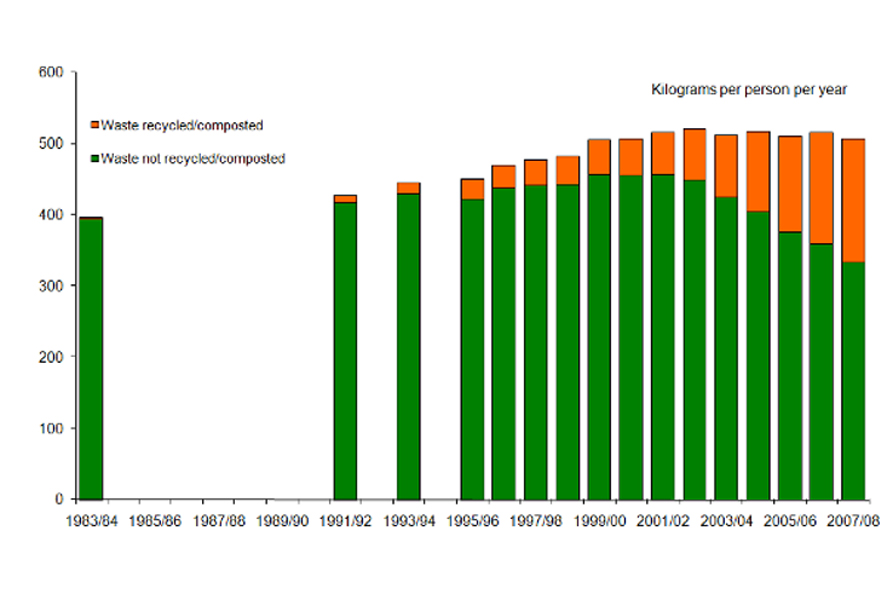 Describe and comment on the pattern shown in the graph above.
|
Waste Management Hierarchy
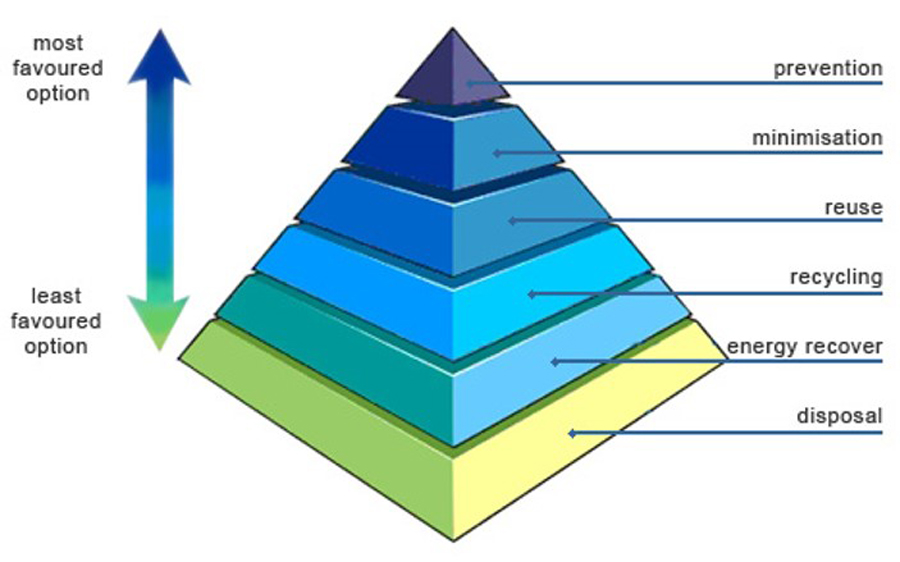 “Total diversion rates” is the amount of material, in kg/household/year that is recycled/composted instead of going to landfill.
|
London and recycling
Questions
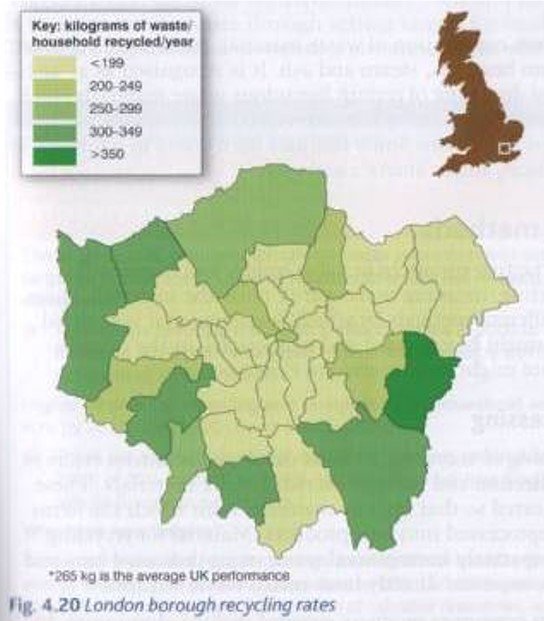
1. Study the map in fig 4.20
- Describe the pattern shown
- Suggest reasons why a high number of boroughs may fall below the national average?
|
Issues surrounding recycling
How would the following affect rates of recycling?
- Transport (cost and ease of access)
- Education of population
- Demographics of population
- Ease of collection and recycling (pro-activeness of local authority)
- Lifestyles
|
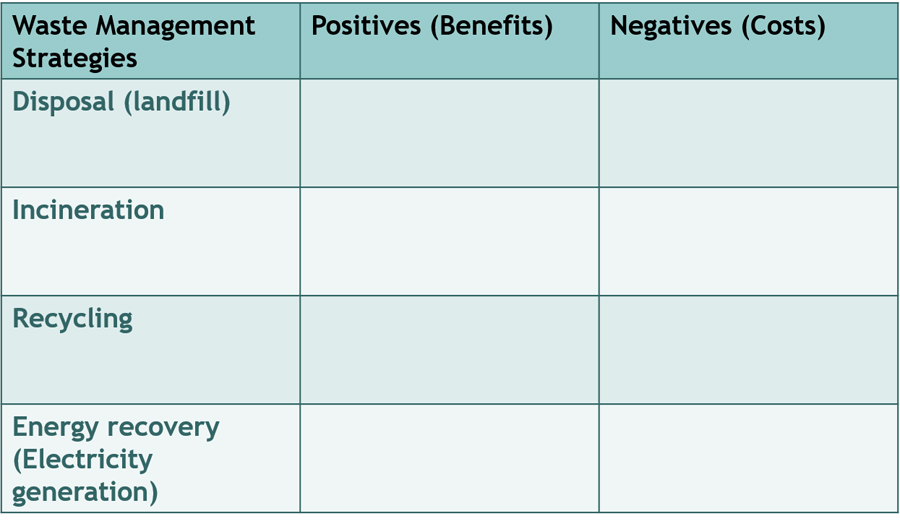
Make Your Own Table
|
Waste management methods: Disposal
- Burying waste is not the preferred way
- We are running out of sites
- We now using old mines, quarries as more environmentally friendly sites
- When badly managed they can pollute groundwater, release gases into the local environment (methane and carbon dioxide mostly)
|
Waste management methods: Incineration
- Combustion of waste is a practical, but controversial method
- In these days of greenhouse gas awareness and airborne pollutants, including PM10s, this is not the preferred method
- However, it is possible to gain electricity from this through energy recovery systems
|
Waste management methods: Recycling
- Resources can be reused, or calorific content used to create electricity
- Physical reprocessing is the most popular and involves the collection and reuse of raw materials. Household bins are now common
- Biological reprocessing involves organic waste used for composting (food stuffs, garden waste, even paper). Compost can be used for gardening processes and even gas production. Technology is being increasingly developed in this field
|
Getting electricity from waste (Energy Recovery)
- Mechanical Biological Treatment (MBT)
- Mechanical Heat Treatment (MHT)
- Advanced Thermal Treatment (ATT)
- Energy-from-waste (EfW)
|
Getting electricity from waste (Energy Recovery)
Mechanical Biological Treatment (MBT)
- MBT mechanically extracts ‘dry’ recyclable materials and uses microbes to convert ‘wet’ organic materials into a compost-like residual material. Some systems use anaerobic digestion (AD) to produce a biogas that can be burned to generate electricity.
|
Getting electricity from waste (Energy Recovery)
Mechanical Heat Treatment (MHT)
- MHT uses pressurised steam to ‘cook’ waste prior to sorting and further processing/incineration of fibre material and treatment of food waste. Waste that has been treated in this way still requires a final disposal route, such as incineration.
|
Getting electricity from waste (Energy Recovery)
Advanced Thermal Treatment (ATT)
- The ATT process heats waste in a low oxygen or oxygen-free chamber to produce combustible ‘syngas’, which can be burned to generate electricity. Has a limited track record on municipal waste.
|
Getting electricity from waste (Energy Recovery)
Energy-from-waste (EfW)
- Burning of residual waste at high temperature. The process captures resulting hot gases and uses them to generate electricity and hot water. EfW is a proven technology that has been used for many years in Europe.
|
Waste management methods: Waste reduction
This prevents creation of extra waste. Simple exercises like…
- Re-using second-hand products
- Repairing/recycling broken items
- Designing reusable items, e.g. shopping bags over recent years
- Avoid excessive packaging
- Encourage consumer use of re-usable products
- Designing lightweight products that use less materials
|

 Learning outcomes:
 To be able to:
 Where are we on our specification?