- refers to the spatial coverage of the hazard. This can refer to the area affected by a single event, some of which can have a very localised effect, while others have a much wider effect, such as tsunamis which can cross large oceans.[?]
the severity of which will depend upon
• the magnitude of the earthquake,
• its depth,
• the distance from the epicentre and
• the local geological conditions. [?]
- visible breaking and displacement of the earth’s surface, probably along the line of the fault.
- poses a major risk for large engineered structures such as dams, bridges and nuclear power stations.
• collapsing buildings;
• destruction of road systems and other forms of communication;
• destruction of service provision such as water, electricity and gas;
• flooding;
• disease;
• food shortages;
• disruption to the local economy, either subsistence or commercial. {[?]
Tsunamis
What do you already know about Tsunami?
Tsunamis
- giant sea waves (tsunami means ‘harbour wave’ in Japanese) generated by:
shallow-focus underwater earthquakes (the most common cause)
volcanic eruptions
underwater debris slides and
large landslides into the sea.
Tsunamis
Read the information about tsunamis on pages 203-204 in the Hodder textbook 4th edition, then answer the following questions:
• a very long wavelength (sometimes over 100 km) and
• a low wave height (under one metre) in the open ocean
• travel quickly at speeds of over 700 km per hour
• when reaching shallow water bordering land, increase rapidly in height.
• the height of the waves and the distance they have travelled
• the length of the event (at source)
• the extent to which warnings could be given
• coastal physical geography, both offshore and on the coastal area
• coastal land use and population density
• associated with the tectonic activity taking place around its edges.
• most are generated at convergent (destructive) plate boundaries where subduction is taking place, particularly on the western side of the Pacific and the bordering eastern side of the Indian Ocean (25 per cent of all events).
Tsunamis
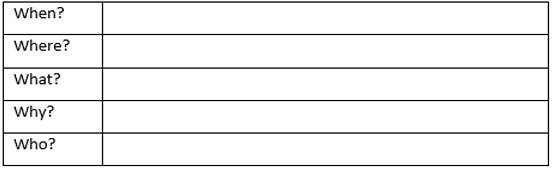
Using information from p.204 the Hodder textbook) and/or the internet, complete the 5Ws table below for either the December 2004 Boxing Day tsunami or the March 2011 Tohoku tsunami.
Challenge:Describe the characteristics of tsunamis and explain their formation [9 marks].
Review
Could the UK ever be affected by a tsunami? Watch to find out more & note key points.
Homework
Find photographs on the internet of two urban areas
in very different parts of the world that have suffer
from devastating tsunamis (not the cities covered in
Hodder textbook). Use your observational skills to describe
the damage shown in each photograph, in particular
focusing on the differences that may be seen. If you
identify any major differences, try to explain how they
have come about.
Due: 28 February 2023
Map
Warning: Trying to access array offset on null in /home/www/public/teach/lesson.php on line 361