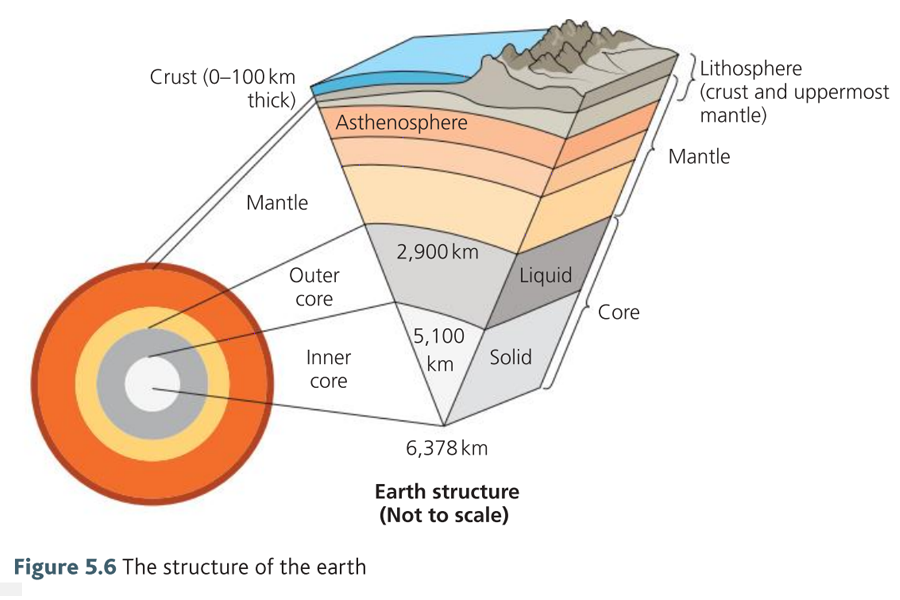
is made up of dense rocks containing iron
and nickel alloys and is divided into:
a solid inner core and
a molten outer one, with a temperature of over 5000 °C.
This heat is produced mainly as the result of two processes:
primordial heat left over from the Earth’s formation and
radiogenic heat produced by the radioactive decay of isotopes, particularly Uranium-238, Thorium-232 and Potassium-40.
Mantle
The mantle is made up of molten and semi-molten rocks
containing lighter elements such as silicon and oxygen.
Crust
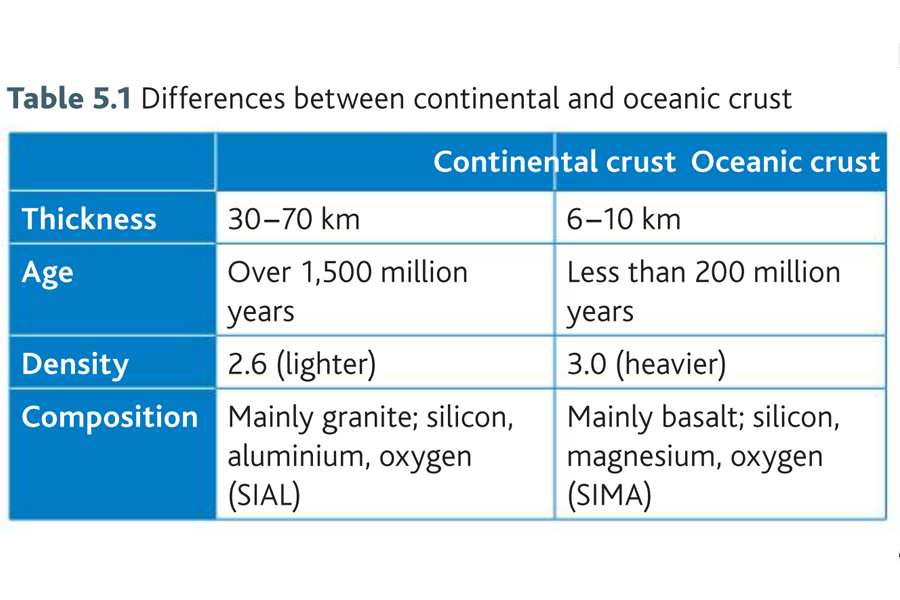
The crust is even lighter because of the elements that
are present, the most abundant being silicon, oxygen,
aluminium, potassium and sodium. The crust varies in
thickness – beneath the oceans it is only 6–10 km thick
but below the continents this increases to 30–40 km
and under the highest mountain ranges this can be as
high as 70 km.
Lithosphere
The lithosphere consists of the crust and the rigid
upper section of the mantle and is approximately 80–90
km thick. This is the section of the Earth that is divided into seven very large plates and a number of smaller ones (Figure 5.6). Plates are divided into two categories, oceanic and continental, depending on the type of
material from which they are made (see Table 5.1)
Asthenosphere
The asthenosphere lies beneath lithosphere and is semi-molten on which the plates float and move.
TASK 2:
How do we know that tectonic plates are moving?
What is the theory of plate tectonics?
What evidence did Alfred Wegener use to support his ideas about plate movement?
TASK 3:
There are two types of plate – oceanic and continental.
Where two plates meet it is known as a boundary or a margin.
Review
Start Quiz!
Homework
Warning: Trying to access array offset on null in /home/www/public/teach/lesson.php on line 350
Map
Warning: Trying to access array offset on null in /home/www/public/teach/lesson.php on line 361